PROJECT OVERVIEW
Onboarding strategy at Learn Taíno
Client
Team
Cross-functionally: UX writing, product management & dev
Tools
Timeline
My specific contributions:
Edited usability testing guide
Led affinity diagramming
High fidelity screens (8)
Stakeholder presentation
Will an intro lesson survive the sign-up funnel?
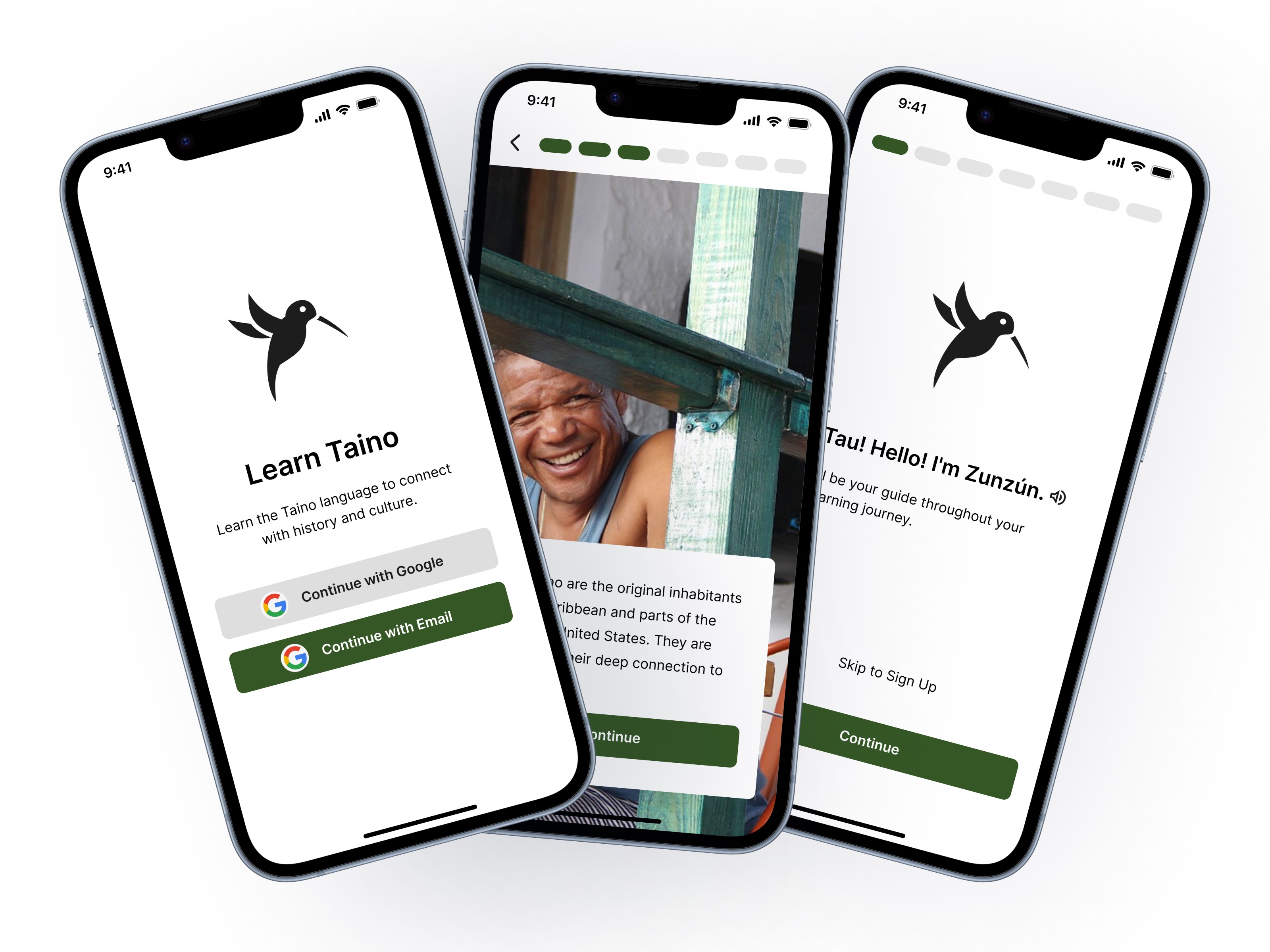
Learn Taíno is a mobile app created with Casa Areyto to teach a modern variant of Taíno, an Indigenous Caribbean language. Unlike typical apps, it opens with a culture-rich lesson on Taíno history—educating users on colonization’s impact and the importance of preserving language.
This story-first approach supported the app’s social mission, but raised a key question: Would it impact sign-up rates? With the product still in MVP, we set out to validate the flow before development progressed.
My role:
Evaluate user response to story-first onboarding
Identify friction points before full development
Propose UX improvements based on testing findings
THE FINAL SOLUTION
A smoother start
To streamline sign-up while still teaching about Taíno culture, we:
Moved the history lesson & quiz to a dedicated in-app section for users to explore at their own pace
Shifted focus to storytelling, highlighting what users would learn and why it matters
Reduced the sign-up flow from 37 screens to just 11, removing friction and keeping users engaged

OUR APPROACH
Research methods & rationale
We conducted a mixed-methods study that combined:
Remote, moderated usability testing
User interviews
Single Ease Question (SEQ)
Why this approach?
Access dispersed participants effectively
Capture real-time feedback
Facilitate sensitive, meaningful conversations (culture + colonization)
Allow comparison of section performance (SEQ)
PRIMARY FINDING
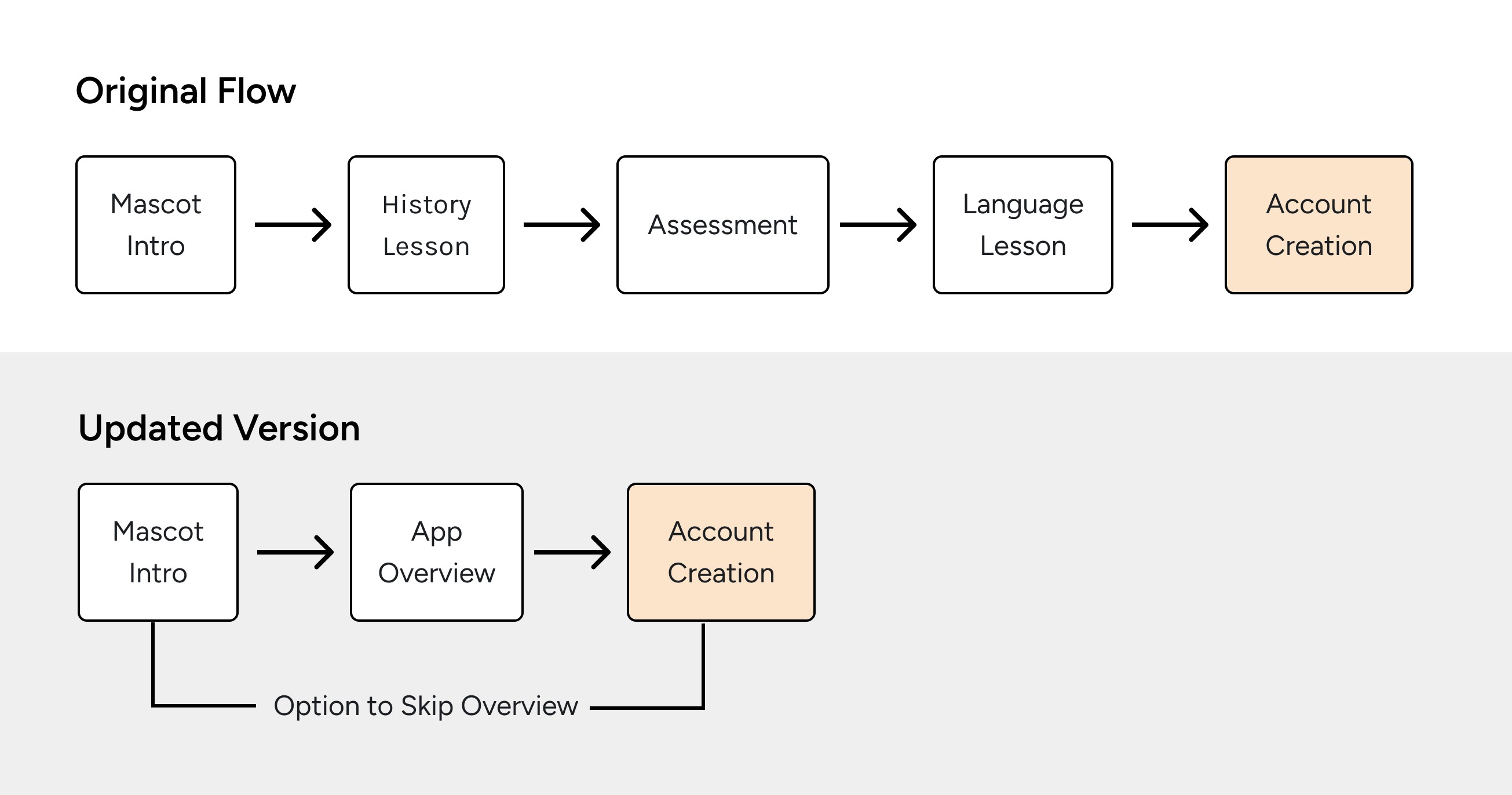
History lesson = low SEQ score
Mascot intro
History & culture
Language lesson
Account creation
User quotes:
"I was taken by surprise with the quiz, but I like that you can go back and check the content."
"Is there a penalty for getting a question wrong?"
"I could foresee issues with not paying enough attention for the first question."
SECONDARY FINDINGS
Unexpected data
The app's content dwelled too much on the negative impacts of colonization.
Users found the mascot's role unclear, but appreciated the sense of companionship.
User quotes:
"Using 1492 as the reference makes it seem like our history began when the Europeans showed up."
"Don't focus on European perspective in lessons on Taíno history. It's important to the story, but better to prioritize indigenous voices."
"Now it's like I'm learning with a pal. Very engaging!"
FIRST ROUND ITERATIONS
Key information architecture changes
After testing, we made the following improvements:
Reorganized intro flow:
Removed the History & Culture lesson
Added a brief overview and a skip option for quicker sign-up
Balanced Historical Context:
Acknowledged colonization but centered Taíno values and culture
Improved Accessibility:
Enhanced contrast, darkened colors, and added more intuitive cues
SECOND ROUND ITERATIONS
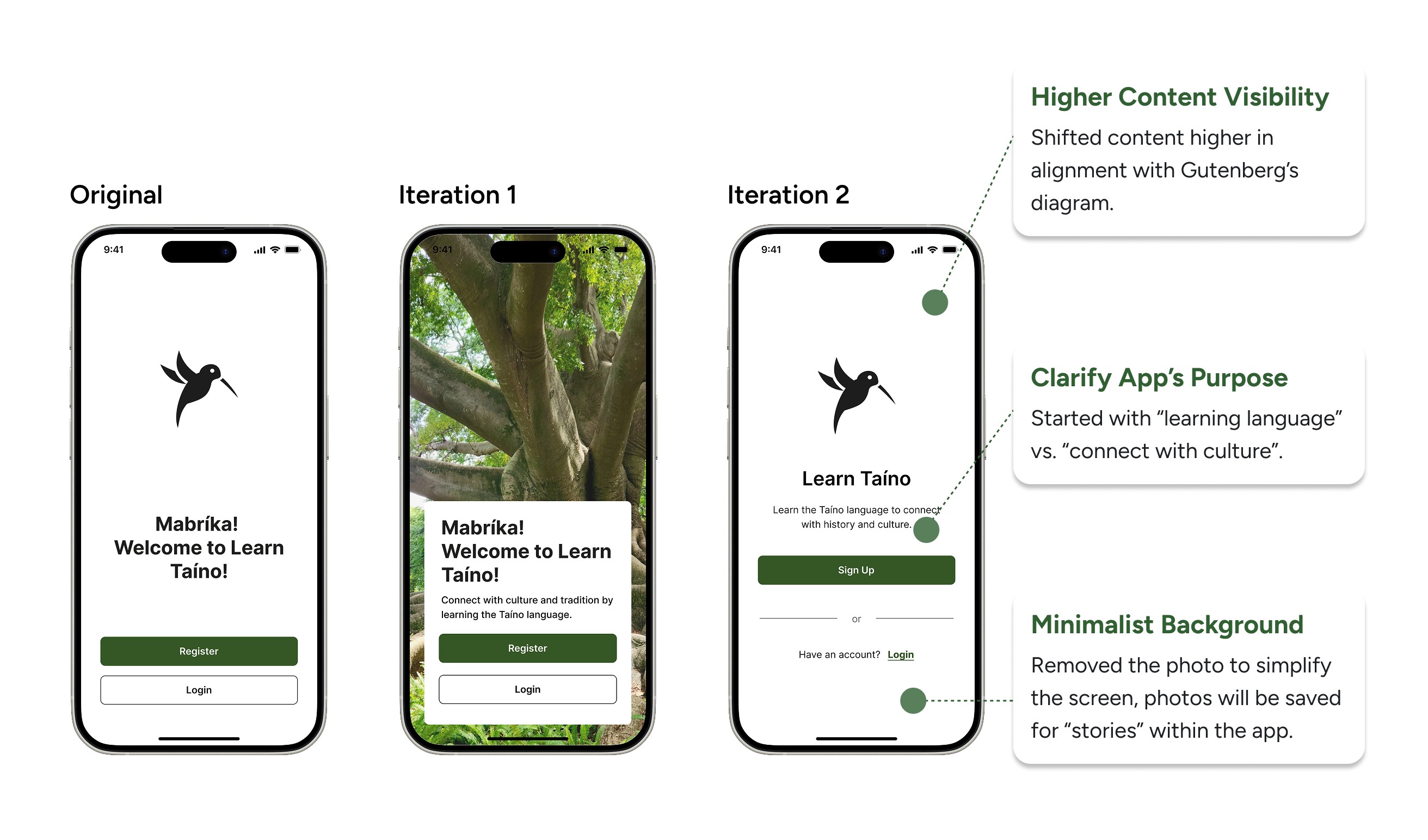
Aesthetic changes
In the second round of usability testing, the new sign-up flow was clear and streamlined, but the welcome screen needed improvements to better guide users.
RESULTS
Project impact
Simplified sign up
Reduced the flow from 37 screens to 11, making it easier for users to get started.
Strong first impressions
Usability testing showed faster task completion and more excitement around learning with revised flow.
Decolonized experience
Visual and content updates shifted focus towards celebrating indigenous voices throughout the app
How my work has evolved
Consider the spectrum of users: Our app must engage both passionate activists and those exploring the language more casually.
Highlight Taíno culture beyond colonization – Focusing content on pre-colonial history and modern resilience will provide a decolonized experience.